
You spray your perfume before leaving the house. It smells fresh, bright, maybe a little citrusy. By mid-morning, it has shifted into something warmer, fuller. By evening, what is left on your skin is almost unrecognisable from what you put on. That is not your skin “eating” the perfume. That is how every fragrance is designed to work.
Most people never know this. They judge a perfume in the first two minutes at a counter and either buy it or walk away. Those two minutes are the least representative part of the entire fragrance. The opening is not the perfume. It is just the first scene.
Understanding how perfume notes unfold changes how you shop, how you wear, and how much money you stop wasting on bottles that smell nothing like what you tested.
Every perfume is built in three stages: top notes, heart notes, and base notes. Each stage is made of different molecules with different weights.
Lighter molecules lift off the skin fast. Heavier molecules sit close and evaporate slowly. The result is a fragrance that changes across the day, by design.
Perfumers call this the fragrance pyramid. Top notes sit at the peak because they are the first thing you smell and the first thing to disappear. Heart notes form the middle, the longest phase, and the real personality of the perfume. Base notes sit at the foundation, the warmth that stays after everything else has faded.
Most fragrances are not built from isolated single ingredients. They are built from accords, which are deliberate blends of multiple notes designed to create one impression.
A “leather accord” is not a leather extract. It is a combination of materials chosen to smell like leather. When you read a note list on a bottle, you are reading the ingredients. What you actually experience is the accord.
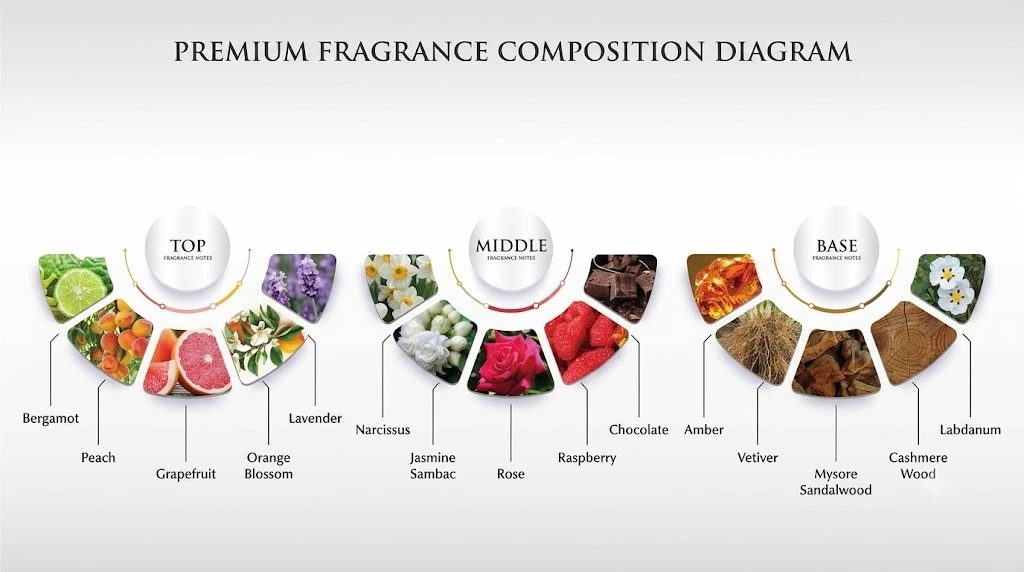
Top notes are the opening scene. They hit your nose immediately and disappear within 15 to 30 minutes, regardless of concentration.
The classic top note materials are:
The reason they vanish so quickly is chemistry. Limonene, the molecule that makes lemon smell like lemon, has a low boiling point. Your body heat is enough to push it off the skin within minutes. A citrus top note in an expensive extrait de parfum still disappears as fast as one in a cheap EDT. The base lasts longer. The citrus does not.
This is where the most expensive mistakes happen. Someone sprays at a counter, the opening smells sharp and synthetic, and they put the bottle down. Or the opening smells beautiful, they buy it, and two hours later, it has turned into something they do not recognise on their skin. Both decisions were made on incomplete information.
The opening of a fragrance is the sales pitch. The heart is the product.
Heart notes emerge about 20 to 30 minutes after application and carry the fragrance through its longest phase. This is the part of the perfume that people remember. This is what someone smells on you at a dinner or catches a trace of when you leave a room.
Common heart note materials include:
Take Flordessy by Signature by Cybele as a clear example of how this plays out in practice. The opening comes in with bergamot and pepper, bright and lifted. It smells fresh. It smells like a good start.
But the bergamot fades fast, and by 30 minutes, rose, violet, and ylang-ylang have moved in. That is where Flordessy actually lives.
The heart is velvety, feminine, and floral without being sharp. The bergamot-pepper opening was just the door. The floral heart is the room.
When you sample any fragrance, this is the phase you are evaluating. Spray it, leave it alone for an hour, and come back to it. Whatever you smell then is the fragrance you are deciding on.
Around the 20 to 40 minute mark, most fragrances go through an awkward transition. The top notes are mostly gone, and the heart has not fully settled. The fragrance can smell flat, a little sharp, or just off.
This is normal. This is not the fragrance going bad on your skin. It is a transition, and it passes.
Most people spray a sample, sniff it once or twice while the top notes are still fading, lose interest during the rough patch, and write the whole fragrance off. I have done this. It is a reliable way to miss fragrances you would have loved if you had given them 45 minutes.
The rule I use: spray in the morning, forget it exists, and smell your wrist at lunchtime. Whatever is there at hour two is closer to a real verdict than anything you smelled in the first five minutes.
Base notes emerge slowly and stay the longest. By hour two or three, the heart has mostly faded, and what is left on your skin is almost entirely base. This can last six to ten hours, sometimes longer, depending on concentration and skin type.
Common base note materials:
The dry-down is also the phase that creates emotional memory. The reason you can catch a whiff of something on the street and suddenly remember a specific person or place is that that memory is tied to a base note. Vanilla, sandalwood, musk. The heavy, warm materials that linger long after the brightness is gone. Perfumers call these “memory anchors” for a reason.
In Flordessy, the base is vanilla and musk. It takes the floral heart and gives it warmth. By evening, the rose and violet have softened, and what stays is a quiet, close-to-skin sweetness that does not announce itself to the room anymore. It becomes something personal. That shift, from the public opening to the intimate dry-down, is the full arc of wearing the fragrance.
Two fragrances can open with identical bergamot-and-pepper accords and end up completely different by hour four. The base is why.
The same opening over a vanilla-amber base dries down warm and sweet. Over an oud-vetiver base, it dries down dark and smoky. The base does not just sit at the bottom of the fragrance. It pulls the top and heart notes in its direction even while they are still present.
Skin chemistry adds another layer. Your pH, oil production, and skin microbiome all interact with base notes in particular.
Two people wearing Flordessy will smell largely similar in the first hour. By hour six, they may be noticeably different. Neither is wrong. That is just their skin working with the base materials differently.
Signature by Cybele · Occasion Finder
Every event has a mood, and every mood has a scent. Tell us where you're headed and what you're wearing, and we'll match the notes that belong there with you.
10 questions · about 2 minutes
Think mood, setting, outfit — we'll do the matching.
Almost there
One last thing — what's your name?
We'll use it to personalise your match.
Knowing a fragrance’s base opens up the practical skill of layering: applying two fragrances together to create something richer than either alone.
The simplest approach is matching bases. Two fragrances that share a vanilla-musk base will blend into each other and extend the dry-down rather than clash. A vanilla-based EDP layered with a sandalwood body oil will sit warmer and longer on the skin than the EDP alone, because the oil slows down evaporation.
The contrasting approach is more interesting. A clean white-musk base fragrance layered under something with an oud or resin base will create contrast, clean on top, and depth underneath. The top notes of each will still do their separate thing, but the dry-down will read as one complex scent.
The rule: if you are unsure whether two fragrances will work together, spray one on each wrist and let them both dry down. If you prefer the left wrist at hour three, start with that one as your base and add the other lightly over it.
Not all fragrance families perform the same way in heat.
Heavy bases (oud, amber, vanilla, resins) amplify in warmth. A fragrance that smells balanced in an air-conditioned room can become overwhelming outside in the Lagos heat. This does not mean you cannot wear them. It means you wear less and apply to covered skin (wrists under a sleeve, behind the knee) so body heat does the work without the outside heat amplifying it too fast.
Lighter bases (white musk, cedar, vetiver, aquatics) handle heat better. They still project, but they do not go sharp or sour under humidity the way heavy orientals can.
If you are choosing a daily fragrance for Nigerian weather, a floral heart over a light musk base, which is exactly the profile of Flordessy, sits well in heat without going flat or heavy.
The bergamot-pepper opening gives you the morning brightness. The floral heart carries you through the day. The vanilla-musk base softens for the evening.
The heavy gourmands and thick orientals in your collection are not retired. They are better reserved for harmattan season, evening events, or air-conditioned environments where they can behave.
Four practices that actually work:
Sample across the full dry-down before buying. Ask for a sample strip, spray your wrist, and check it three hours later. Do not buy on the opening. If you love the dry-down, buy the bottle.
Write down what you like about each fragrance you own. Not the marketing language. The specific: “I like how this smells at hour four, warm and slightly smoky.” Then look for those characteristics in new fragrances. “Warm base, slightly smoky dry-down” is more useful than “I like Flordessy.”
Test one new fragrance at a time. Testing three fragrances in one shopping trip means you cannot accurately evaluate any of them. Your nose adjusts, and the third fragrance you smell will always seem like the odd one. Pick one, live with it, come back for the next.
Trust the base, not the bottle description. A long, romantic note list on the packaging tells you nothing about whether the fragrance will work on your skin. A short note list on a great fragrance tells you everything. The length of the list and the quality of the result are not connected.
Signature by Cybele · Character Finder
Your fragrance should say who you are before you say a word. Answer ten questions about how you move through the world, and we'll uncover the notes that carry your identity.
10 questions · about 2 minutes
There are no wrong answers here — only the truest ones.
Almost there
One last thing — what's your name?
We'll use it to personalise your character notes.
Fragrance notes are the architecture behind why a perfume can feel like three different things across one day.
Once you know where you are in the timeline, shopping becomes less of a gamble and wearing becomes more intentional.
The short version: ignore the opening, evaluate the heart, fall in love with the base. That is the real fragrance.