
Different Types of Perfume Strengths
Stop wasting money on fleeting scents. Discover the notes that project for hours. Why concentration isn't everything, and how to choose the heaviest-hitting fragrance notes.

Ever sprayed on your favorite fragrance in the morning only to wonder by lunchtime if you’re even wearing anything at all? You’re not imagining it. Perfume strength isn’t a fixed trait stamped on the bottle — it’s the outcome of a constant negotiation between chemistry, climate, and your own body.

From the molecular weight of the raw ingredients to the humidity in the air and the moisture on your skin, a dozen invisible factors decide whether a scent whispers or roars.

Understanding these forces doesn’t just satisfy curiosity — it’s the key to choosing fragrances that perform the way you expect, and getting more mileage out of every bottle you own.

Below, we break down exactly what determines how strong, how long-lasting, and how far-reaching a perfume really is.
perfume contration image two

Key Factors That Affects Perfume Strengths

Perfume strength is not determined by the bottle’s oil concentration alone. While the official category label (like EDT or EDP) provides a baseline, a fragrance’s actual performance, staying power, and projection are heavily altered by chemical, environmental, and physical factors.The key elements that dictate how strong a perfume behaves are broken down below.

Signature by Cybele · Scent Finder

Finding Your Signature Scent

Not your character. Not your calendar. Just you — how you move, what you're drawn to, how you want to be remembered in a room. Answer honestly and we'll find the notes that are already yours.

10 questions · about 2 minutes

Go with your gut on each one — the first answer is usually the true one.

Question 1 of 10 10%

Almost there

One last thing — what's your name?

We'll use it to personalise your signature scent.

Your Signature Scent

Top Notes

Middle Notes

Base Notes

1. The Molecular Weight of Fragrance Notes

Not all fragrance ingredients are created equal. The raw materials used in a perfume’s recipe have varying chemical structures that impact how quickly they break down:
  • Volatile Light Molecules: Citruses (lemon, bergamot), green herbs, and light fruits consist of small, light molecules. Even in a high-concentration Parfum, these notes evaporate rapidly.
  • Dense Heavy Molecules: Woods (sandalwood, cedar), resins (amber, benzoin), vanilla, musk, and oud consist of large, heavy molecules. They cling tenaciously to surfaces and evaporate very slowly, giving any perfume a naturally longer life.
  • The Reality: A citrus-heavy Eau de Parfum will almost always fade faster than a woody-amber Eau de Toilette because of the raw materials used.
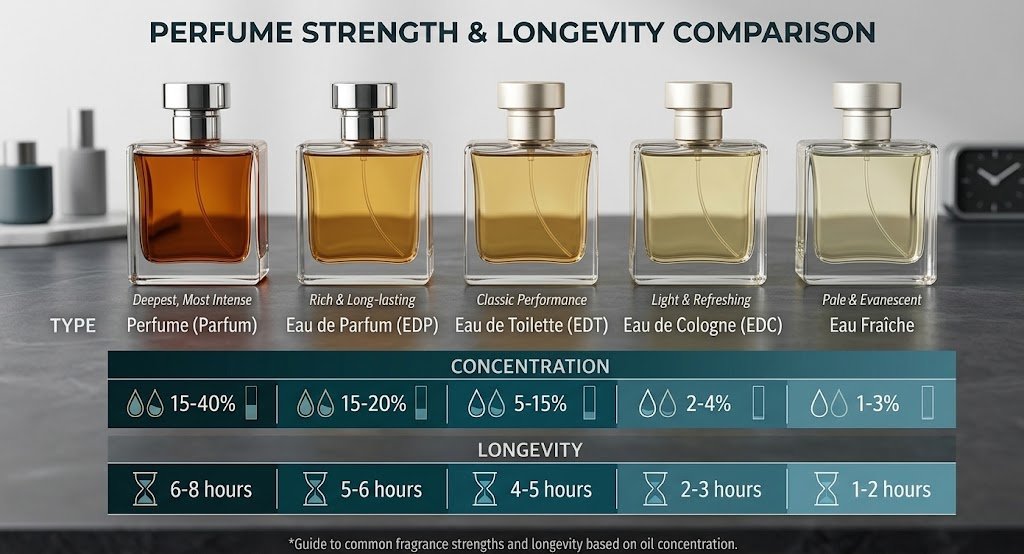
image explains perfume strength and longevity together with concentration

2. Ambient Temperature and Climate

Weather is one of the most dynamic external forces acting on perfume oils:

  • Heat and Humidity: High temperatures act as an energy catalyst. Heat causes alcohol and fragrance oils to evaporate at an accelerated rate. This causes a perfume to project aggressively (creating a massive “scent cloud”), but it burns through its lifespan much quicker.
  • Cold Weather: Cold air slows down evaporation. Fragrances compress and stay closer to the skin, making them feel weaker. This is why heavy, sweet, and resinous perfumes are preferred in winter—the cold air tames their intensity.
signature by cybele products

Spin The Wheel

What's Your Fragrance Personality?

A good perfume should reflect who you are — not try to change you. Give it a spin and see which trait, and its fragrance match, comes up.

3. Skin Chemistry and Hydration

Your skin acts as the final canvas for a fragrance, and its biological state changes how the strength develops:

  • Moisture Levels: Fragrance oils are lipophilic, meaning they dissolve in and bind to fats and oils. Dry skin lacks the lipids needed to anchor perfume, causing the alcohol to carry the scent away rapidly. Hydrated or naturally oily skin locks the fragrance molecules in place, significantly extending longevity.
  • Skin pH and Heat: Variations in body chemistry and surface body temperature alter how quickly the notes transition. A higher body temperature will cause the heart and base notes to reveal themselves much faster.

4. Olfactory Fatigue (Scent Blindness)

Sometimes, a perfume’s perceived drop in strength is entirely psychological. Olfactory fatigue is a survival mechanism where your brain tunes out a continuous sensory input to stay alert to new smells.

  • Stronger perfumes with heavy synthetic aroma-chemicals (like Iso E Super or Ambroxan) are notorious for causing immediate scent blindness.
  • You may believe your perfume has completely vanished after an hour, while people walking past you can still smell it vividly.

5. Storage Conditions and Oxidation

How a bottle is treated over time alters the structural integrity of the fragrance oil matrix:
  • The Enemies: Direct sunlight (UV rays), fluctuating humidity, and heat degrade chemical bonds.
  • The Effect: Constant exposure to a warm, damp bathroom breaks down the delicate top notes first. Over time, this oxidation can make a perfume lose its original punch, causing it to smell sour, metallic, or significantly weaker than when it was first unboxed.
perfume strength

Strongest Perfume Notes by Category

Base notes are the strongest and longest-lasting perfume ingredients because they consist of heavy, dense molecules that evaporate very slowly.

Resinous & Sweet Notes

  • Amber: Warm, sweet, and sticky note that binds tightly to the skin to project for hours.
  • Vanilla: Deep, comforting molecular note with some of the highest natural staying power in perfumery.
  • Benzoin / Labdanum: Heavy, balsamic resins that act as powerful fixatives to make entire fragrances last longer.

Woody Notes

  • Oud (Agarwood): An incredibly dense, rich, and pungent wood note known for maximum sillage and longevity.
  • Sandalwood: A creamy, rich wood that creates a persistent, smooth trail throughout the day.
  • Cedarwood: A dry, sharp wood note that retains its strength exceptionally well in cold weather.

Earthy & Musk Notes

  • Patchouli: Dark, earthy, and slightly sweet note used as a powerhouse anchor in intense fragrances.
  • Musk: A warming, animalic, or clean synthetic note that creates an enduring, skin-like projection.
  • Oakmoss: An intense, bitter-earthy moss note that provides a heavy, vintage-style lasting power.

Spicy & Smoky Notes

  • Leather: A smoky, deep, and pungent accord that maintains its raw strength all day.
  • Tobacco: Rich, sweet, and smoky note that offers heavy projection and a dense scent trail.
  • Cinnamon / Clove: Intense, warm spices that cut through cold air and boost the fragrance’s initial power.

Heavy Floral Notes

  • Tuberose: One of the few non-base notes with massive strength; a narcotic, creamy white floral that can dominate a fragrance.
  • Jasmine: A rich, indolic floral note that carries significantly more weight and longevity than lighter flowers.

How Note Volatility Affects Perfume Strength

Perfume notes are categorized into a fragrance pyramid based on their evaporation rates:

Note TierEvaporation RateTypical IngredientsContribution to Strength
Top NotesVery Fast (5–15 mins)Citrus, Berries, Light HerbsProvides initial blast, low lasting power
Heart NotesModerate (2–4 hours)Rose, Jasmine, Lavender, CinnamonForm the core personality of the scent
Base NotesSlow (4–8+ hours)Oud, Amber, Patchouli, Vanilla, MuskDrives the true longevity and heavy sillage

Is there any difference between perfume strength and perfume concentration?

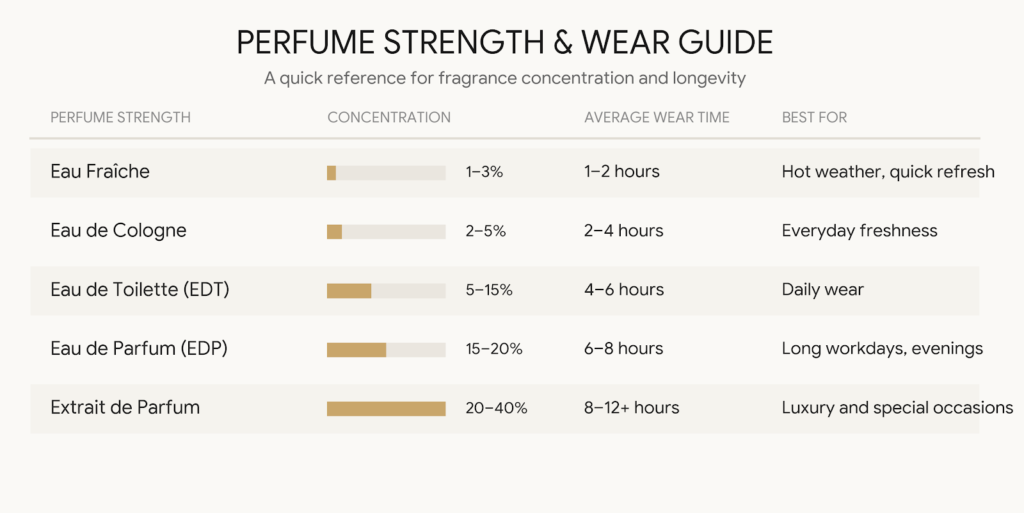
Yes, perfume concentration is the physical amount of fragrance oil in the bottle, while perfume strength is how powerful, loud, and long-lasting that fragrance actually behaves on your skin.

While higher concentration often leads to better strength, they are not the same thing.

The Core Differences

FeaturePerfume ConcentrationPerfume Strength (Performance)
What it isThe exact percentage of pure fragrance oil mixed with alcohol and water.A subjective mix of longevity (how long it lasts) and projection/sillage (how far it radiates).
How it’s measuredStrictly by industry categories (e.g., Eau de Toilette vs. Eau de Parfum).By how the notes interact with air, skin chemistry, and temperature.
Controlled byThe manufacturer during production.The chemistry of the specific perfume ingredients used.

Final Thoughts: Mastering Your Fragrance's Performance

Perfume strength was never about luck. It’s a predictable outcome of molecular weight, temperature, skin chemistry, your nose’s own fatigue, and how carefully a bottle has been stored.

Once you understand these forces, you stop guessing and start making informed choices — whether that means reaching for a woody-amber blend in winter, moisturizing before you spray, or simply knowing that “scent blindness” doesn’t mean everyone else stopped noticing too.

The next time a fragrance feels like it’s fading fast, you’ll know exactly which variable to blame — and how to work with it, not against it.